








Eco-friendly house cleaning: less chemicals, more nature
Cleaning your home sustainably means choosing products and methods that minimize environmental impact, reducing the use of polluting and harmful chemicals, avoiding disposable solutions, and limiting water and energy waste. Natural cleaning products like white vinegar, baking soda, and citric acid can help make cleaning more sustainable, but there are also other best practices to follow to reduce the environmental impact of household chores.
Tips for Eco-Friendly Home Cleaning
In short, eco-friendly home cleaning involves using methods and products that reduce environmental impact. Sustainable cleaning isn't limited to the use of natural and biodegradable products; it also requires careful attention to the tools and techniques used, which should be geared toward reducing waste and consuming as little water and energy as possible.
Here are some good practices that allow us to clean the house in a sustainable way:
- Use when possible natural products for cleaning such as vinegar, baking soda, citric acid and essential oils;
- Choosing eco-sustainable detergents free from toxic and polluting substances;
- Avoid using disposable tools like sanitizing wipes;
- Use reusable materials such as microfiber cloths and sponges (possibly made of natural fibers such as bamboo);
- Choosing concentrated detergents or refillable to reduce plastic use;
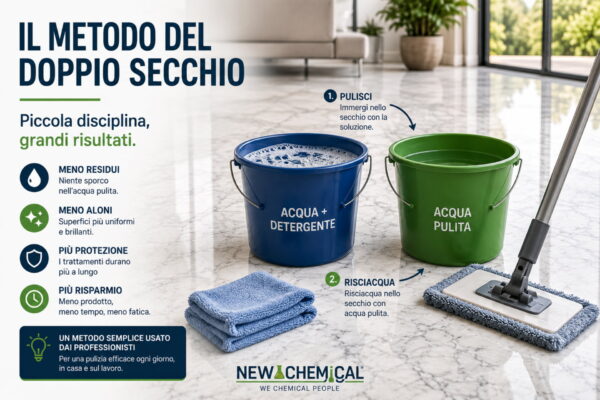
- Do not exceed the quantity of detergent, respecting the dosage instructions;
- Do not use more water than necessary.
For truly eco-friendly cleaning, which also saves on consumption , it is important not to overuse tools that require a lot of electricity such as pressure washers, wet and dry vacuum cleaners and robot vacuum cleaners.
Natural Cleaning Products: Beyond Traditional Remedies
When it comes to sustainable cleaning, it's obvious to immediately think of traditional remedies : natural and harmless substances like baking soda, vinegar, and citric acid can prove very useful in home care. Natural antibacterials like citric acid and tea tree essential oil can be good allies in cleaning sinks, tiles, and floors.
Baking soda , on the other hand, is a powerful stain remover and neutralizes odors, making it a sustainable alternative to chemical compounds such as optical brighteners and air fresheners, which can release large quantities of polluting particles into the air that are potentially harmful to health.
It's true that using only natural cleaning products can be impractical, as you need to know dozens of different recipes, and most solutions need to be freshly prepared. However, there is a sustainable way to clean that goes beyond traditional remedies: we're talking about the new generation of eco-sustainable detergents , which exploit the properties of natural plant-based ingredients and are produced according to high standards of environmental and social sustainability.
Eco-friendly detergents do not contain polluting or potentially harmful chemicals and are formulated with plant-based raw materials . One of the easiest ways to ensure you're choosing sustainable products is to purchase detergents labeled with certifications like the EU Ecolabel , which guarantees much higher environmental standards than traditional detergents.
Other certifications that indicate the most environmentally friendly products are ICEA ECO BIO Detergenza, specific for detergents, and Ecocert , which certifies the quality of raw materials of agricultural origin.
How to clean floors sustainably?
Eco-friendly detergents are an excellent solution, especially when it comes to cleaning floors, which often require daily (or almost daily) care. Let's start with parquet: wood is the material best suited to sustainable cleaning.
We've known about the protective action of natural oils and waxes for centuries : we can therefore opt for more traditional treatments, such as the application of beeswax, or for innovative formulations that exploit and enhance the properties of these substances. The important thing, if we want a truly eco-friendly product, is to ensure it is formulated with plant-based surfactants , preferably Ecocert certified.
Plant-based surfactants, emulsion vegetable oils, and special waxes are also excellent for terracotta and stone floors , as well as outdoor decking and treated wooden furniture. To clean more delicate materials like marble, terracotta, and ceramic , you can rely on neutral, low-foaming detergents based on plant-based raw materials and surfactants.
But even the most unsuspecting floors can be cleaned with eco-sustainable detergents: in fact, there are products based on natural surfactants and vegetable oils specifically designed for the care of vinyl floors, such as PVC and LVT, Luxury Vinyl Tiles.
These types of products are very gentle yet extremely effective: thanks to the properties of natural oils and waxes, they create a protective film on surfaces that facilitates subsequent cleaning and prolongs the effectiveness of treatments, saving time, energy, and resources. They also benefit the environment.